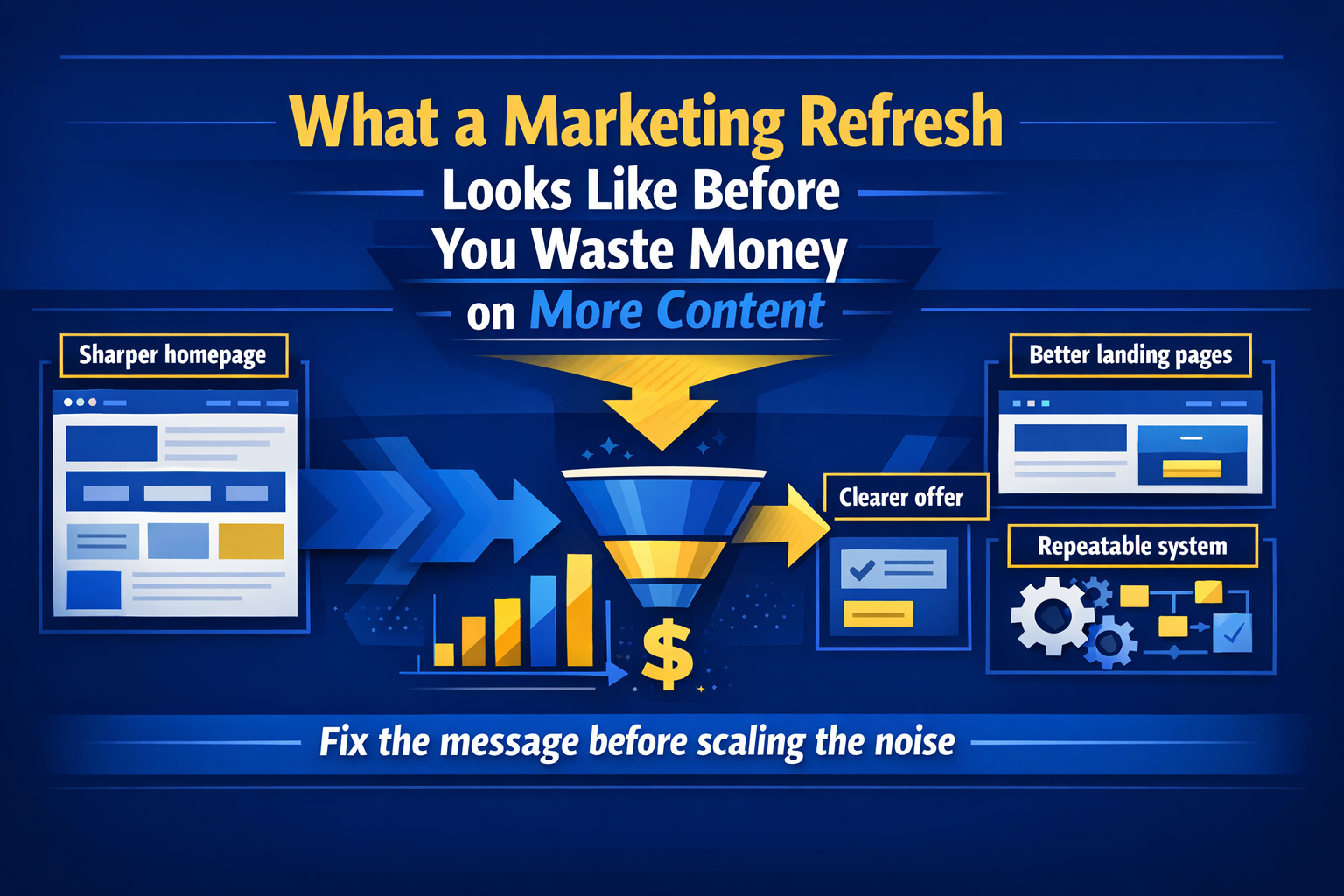

What a Marketing Refresh Looks Like Before You Waste Money on More Content
A marketing refresh fixes the weak parts of your system before you push more traffic, more posts, more AI copy, or more budget into pages that cannot carry the weight. If your homepage is soft, your service pages blur together, and your content has no clean destination, more output will not save you.
Quick Answer
What a marketing refresh does
A marketing refresh is the cleanup work you do before you spend more on content, ads, or channels. It sharpens the message, cleans page flow, maps landing page opportunities, tightens light SEO and AEO structure, and gives the team a repeatable workflow that supports the pages that matter.
If you skip that work, you can spend more and still get the same weak result. More traffic lands on soft pages. More posts point to broad offers. More output creates more motion without more trust.
Why this topic matters now
Businesses feel the squeeze before they hire because the options look bad. Doing more of the same feels wasteful. Hiring a full team feels expensive. A major redesign feels risky. So the company waits, keeps posting, keeps tinkering, and keeps hoping the next round of content fixes a structure problem.
That delay gets expensive because weak pages stay live, weak offers stay visible, and the team keeps spending time on output that does not carry much weight.
Snapshot
What feels stuck before hiring
| Symptom | What leadership feels | What is usually wrong underneath |
|---|---|---|
| “We know we need marketing, but we are not ready to hire.” | Unclear next step | The message is soft and the site does not support action. |
| “We have posted a lot and it still feels flat.” | Frustration with output | Content is not tied to clear pages or clear offers. |
| “The site looks fine but leads are weak.” | Doubt about the website | Page flow and positioning are weak. |
| “AI helped us make more content, but nothing changed.” | Confusion about what AI should solve | Speed increased. Clarity did not. |
| “We do not want to burn money on a full team or giant agency yet.” | Cost caution | The business needs focused cleanup before bigger spend. |
Why businesses feel stuck before they hire
A lot of businesses do not stay stuck because they do not care about marketing. They stay stuck because the next move feels expensive and the current setup feels unreliable.
That creates a loop. Pressure builds. Output increases. Results stay mixed. Hiring feels risky. The problem compounds.
Visual
The stuck-before-hire loop
This is a diagnostic chart, not a market data chart. It shows the pattern most teams fall into before they clean up the structure.
The hidden cost of unclear messaging
Unclear messaging does not only hurt conversion. It weakens the rest of the system. If the homepage says too much and too little at the same time, the business pays for that in several places. Content has to work harder. Ads land on softer pages. Sales conversations start later. Search gets a weaker signal. Internal teams cannot align around one clear point.
Messaging Leak Map
Where unclear messaging costs you
| Messaging issue | What the buyer experiences | What the business pays for |
|---|---|---|
| Broad headline | I am not sure this is for me. | Lower engagement |
| Soft subheading | I still do not know what they solve. | Lower trust |
| Weak service positioning | This sounds like everybody else. | Lower differentiation |
| No proof near the claim | I am not sold yet. | Lower inquiry rate |
| Weak CTA | I do not know what to do next. | Lower conversion |
Weak Version
What weak messaging creates
- Scattered captions
- Scattered pages
- Scattered sales language
- Scattered creative direction
Strong Version
What clear messaging creates
- A homepage that says the point fast
- Service pages that show distinct fit
- Content that supports a real path
- Sales conversations that start warmer
Why spending more without fixing the page flow backfires
Page flow is one of the most ignored parts of weak marketing. A page can have decent design and still lose because it moves in the wrong order. It opens with style before clarity. It dumps too many choices too early. It hides proof too far down. It asks for action before trust is built.
When you put more spend into that setup, the weakness becomes easier to measure, not easier to solve.
Risk Chart
What happens if you spend before the refresh
| If you spend on… | Before refresh | After refresh |
|---|---|---|
| More social content | More activity with weak carryover value | Stronger content tied to stronger pages |
| Paid traffic | More expensive clicks to weak flow | Better chance of stronger conversion |
| More AI output | Faster production of vague messaging | Faster production of sharper, mapped messaging |
| Additional channels | More scattered effort | More consistent distribution |
| Full redesign | Cosmetic improvement with old structure | Stronger performance with clearer structure |
Scorecard
Page flow: weak version vs strong version
| Page element | Weak version | Strong version |
|---|---|---|
| Hero | Brand-first | Problem-first |
| Offer section | Broad list of services | Clear priority and fit |
| Proof | Buried or vague | Visible and relevant |
| CTA | Generic | Specific next step |
| Sequence | Jumps around | Problem → Offer → Proof → Action |
What a marketing refresh should include
A marketing refresh is not a full rebuild by default. It is targeted work that fixes the parts of the buyer journey that keep undercutting the rest of the effort.
Homepage clarity
Your homepage should show the problem, the offer, and the next step fast.
Service positioning
Each service page should show who it is for, what it solves, and why it is different.
Landing page opportunities
Create cleaner paths for distinct offers, buyer problems, verticals, and campaigns.
Light SEO and AEO structure
Use clear headings, internal links, scannable sections, and useful answers.
Repeatable workflow
Give each content piece a destination, a job, and a next step.
Homepage clarity
The homepage should do three things fast: show the problem you handle, show the offer in plain language, and show the next step.
| Section | What it should do |
|---|---|
| Hero headline | Name the problem or outcome clearly |
| Subheading | Explain who it is for and what changes |
| Primary CTA | Tell visitors what to do next |
| Trust section | Show proof, examples, or credibility fast |
| Service path | Help the right visitor find the right page |
Service positioning
Service pages should not sound interchangeable. Each one should answer what problem it solves, who it is for, what changes after the work is done, what proof supports the claim, and what the next step is.
| Weak service page | Strong service page |
|---|---|
| Generic summary | Clear buyer problem |
| Talks about process only | Talks about outcome and fit |
| Same tone as every other page | Specific language tied to demand |
| One-size-fits-all CTA | CTA matched to intent |
Landing page opportunities
If a business solves several problems, one broad service page rarely carries enough precision.
| Opportunity type | Example use | Why it matters |
|---|---|---|
| Problem-based page | Need help with lead follow-up | Matches sharper intent |
| Industry page | Marketing for HVAC companies | Builds trust faster |
| Offer page | Landing page sprint | Cleaner conversion path |
| Campaign page | Social or paid promotion target | Better tracking and message control |
| AEO support page | Clear answer page for a real question | Stronger discoverability for answer-style search |
Light SEO and AEO structure
This does not need to turn into a giant technical project before you act. A light structure should cover the basics that help search systems and answer engines understand the page.
| Area | What to tighten |
|---|---|
| Title and H1 | Clear topic match |
| H2 structure | Question-led or intent-led sections |
| Internal links | Connect blog posts to service and landing pages |
| FAQ | Answer direct buyer questions |
| Copy style | Helpful, specific, people-first language |
| Technical basics | Crawlable, indexable, fast enough, mobile-friendly |
Repeatable content workflow
Content should not depend on weekly panic. A repeatable workflow keeps the message stable, gives every content piece a destination, and makes future production easier.
| Step | Output | Purpose |
|---|---|---|
| Core message | Main offer and positioning | Keeps the story stable |
| Page target | Homepage, service page, or landing page | Gives the content a destination |
| Content angle | Problem, objection, proof, or process | Gives the post a job |
| Distribution | Social, blog, email, video | Extends reach without changing the core point |
| Follow-up | CTA, form, DM prompt, or inquiry page | Turns attention into action |
Why smaller agencies can be the smarter move
A smaller agency can make more sense when the business does not need a giant machine yet. A lot of companies need focused cleanup before they need layers of management, bigger campaign planning, or a full internal department.
Fit Check
Why the smaller-agency model can fit better
| Need | Why a smaller agency can fit |
|---|---|
| Sharper message | Fewer layers between diagnosis and action |
| Better page cleanup | Faster movement on high-impact fixes |
| Leaner spend | Lower overhead to support the work |
| Flexible scope | Easier to start with a refresh instead of a giant retainer |
| Closer execution | Strategy and implementation stay closer together |
Comparison
What you buy first
| Option | Best for | Risk if chosen too early |
|---|---|---|
| Full internal hire | Mature company with clear system and enough volume | The hire spends time sorting weak structure |
| Large agency engagement | Business ready for bigger campaign execution | Spend goes into coordination before clarity |
| Smaller focused agency | Business needs cleanup, sharper pages, stronger system | Limited if the company expects full enterprise scope immediately |
| Do it all in-house without structure | Very small or early-stage team | Random output, slow learning, weak carryover value |
What to fix first if budget is tight
If budget is tight, sequence matters more than volume. Work the stack in order.
Homepage message
Rewrite the headline, subheading, proof placement, and CTA.
Top service page
Fix the page that supports the strongest offer or highest-value demand.
One landing page
Build one page around one specific problem or one high-value offer.
Inquiry path
Clean the form, CTA, and next step.
Content support
Publish content that points toward the stronger page.
Action Table
Tight-budget priority stack
| Priority | Fix | Why it goes early |
|---|---|---|
| 1 | Homepage clarity | It affects the whole site |
| 2 | Strongest service page | It supports current demand |
| 3 | One focused landing page | It gives you a sharper path |
| 4 | CTA and inquiry flow | It protects conversion |
| 5 | Content mapped to those pages | It carries the refreshed message |
Roadmap
30-day refresh roadmap
| Week | Focus | Deliverable |
|---|---|---|
| Week 1 | Messaging cleanup | Homepage hero, offer copy, proof block, CTA |
| Week 2 | Service positioning | Rewrite top service page and clarify fit |
| Week 3 | Landing page build | One problem-based or offer-based page |
| Week 4 | Workflow setup | Topic map, content prompts, internal links, CTA plan |
What to ignore for now
If budget is tight, ignore work that creates motion without improving the path.
Ignore This First
Tasks that can wait
| Tempting task | Why it can wait |
|---|---|
| Full rebrand | A message and page refresh often has a higher short-term return |
| More channels | More channels spread weak structure wider |
| Full SEO overhaul | Start with light structure tied to business pages |
| Daily content grind | The page system should come first |
| Fancy automation | Clean input beats faster chaos |
Decision graph: where to start
| If this is the problem | Start here |
|---|---|
| Site looks fine but inquiries are weak | Homepage clarity and CTA |
| Service pages all sound alike | Service positioning |
| Ads or social traffic do not convert | Page flow and landing page gaps |
| Team keeps creating random posts | Repeatable content workflow |
| Search traffic is weak or unfocused | Light SEO and AEO structure plus page map |
The practical rule
Before you spend more on content, ads, or channels, ask four questions:
- Does the homepage explain the offer fast?
- Does the top service page show clear fit?
- Does at least one landing page match a real buyer problem?
- Does the content workflow point people toward those pages?
If the answer is no, more spend usually magnifies the weakness.
FAQ
What is a marketing refresh?
A marketing refresh is targeted work that sharpens messaging, cleans page flow, improves service positioning, maps landing page opportunities, tightens light SEO and AEO structure, and builds a repeatable content workflow.
Why not spend more on content first?
More content sent into weak pages creates more motion without more trust or more conversion. The structure should come first.
Does a marketing refresh mean a full redesign?
No. A refresh can be much smaller than a full redesign. It can focus on the highest-impact parts of the customer journey first.
What is the difference between a homepage and a landing page?
A homepage gives broad orientation. A landing page handles a more specific problem, offer, or campaign path.
Do small businesses need SEO and AEO structure?
Yes. You do not need a giant project on day one, but clear titles, headings, internal links, scannable sections, helpful answers, and clean page hierarchy go a long way.
Why can a smaller agency be a smart choice?
A smaller agency can often move faster on the high-impact fixes, keep strategy closer to execution, and reduce overhead while the business gets the structure right.
Key takeaways
- A marketing refresh fixes the system before you spend more on distribution.
- Unclear messaging weakens content, ads, page trust, and internal alignment.
- More spend on weak page flow usually backfires.
- A useful refresh includes homepage clarity, service positioning, landing page opportunities, light SEO and AEO structure, and repeatable workflow.
- Smaller agencies can be a smart fit when the business needs focused cleanup before bigger spend.
- Tight budgets call for sequence, not panic.