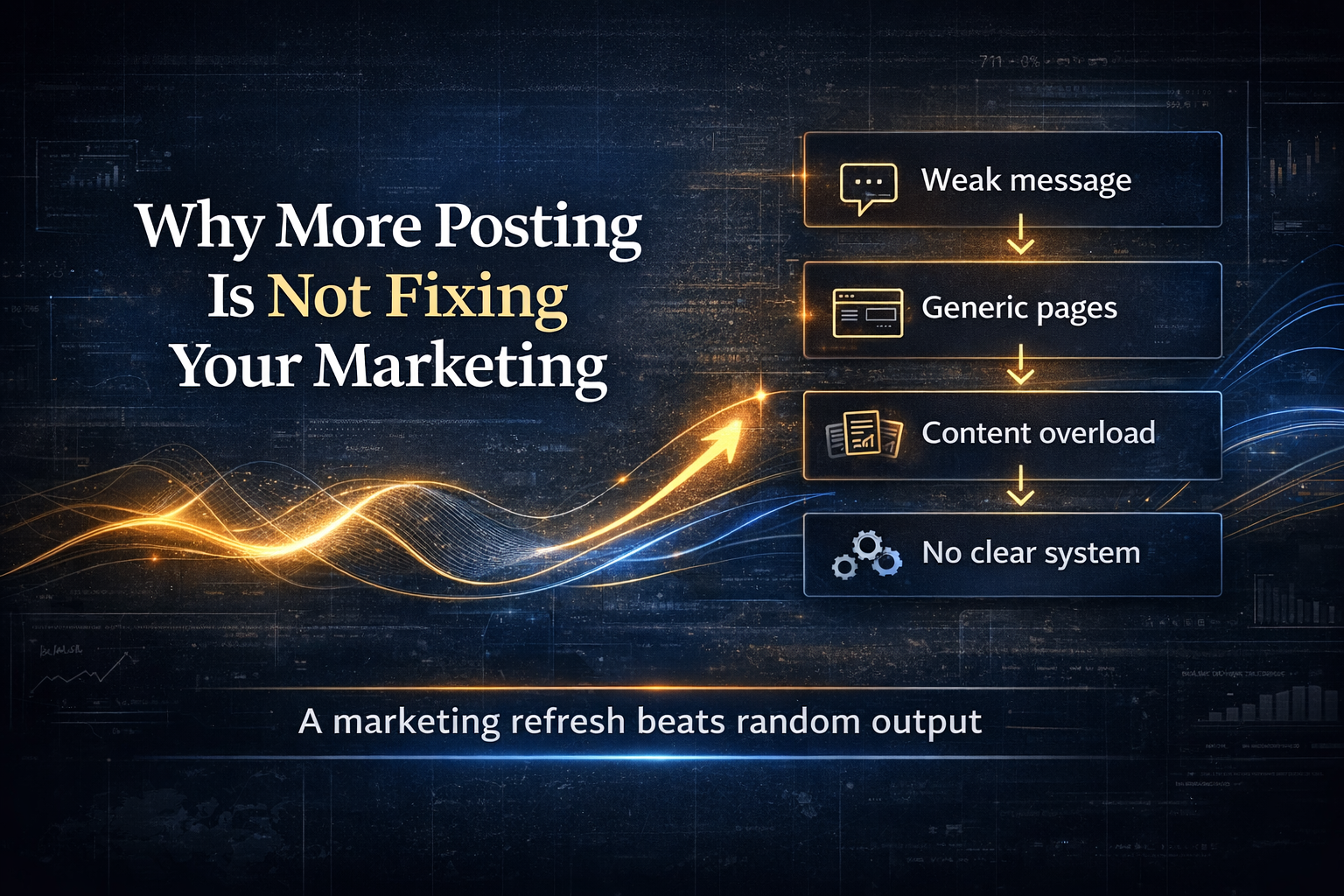

Why Weak Marketing Gets Cut First in a Tighter Economy
Buyers are slower. Budgets are watched harder. Weak homepages, broad service pages, and random content get questioned fast. The work that stays funded is the work tied to clearer demand, better page flow, and a stronger path to inquiry.
Quick Answer
Why weak marketing gets cut first
Weak marketing gets cut first because it looks optional.
A vague homepage feels optional. Random posting feels optional. Broad service pages feel optional. A weak content system feels optional.
Clear lead flow does not feel optional. Strong landing pages do not feel optional. A site that explains the problem fast and moves people toward action is easier to defend when budgets get tight.
Market snapshot: why this topic matters now
The pressure is not in your head. Buyers are more cautious, small businesses are watching costs harder, and search keeps rewarding pages that answer specific questions cleanly.
2026 Market Snapshot
Signals that change the marketing math
| Signal | What it suggests for marketing |
|---|---|
| Small-business optimism softened | Owners are more selective about what stays in the budget |
| Payroll growth weakened | Teams feel more pressure to do more with less |
| Consumer sentiment slipped | Buyers take longer and ask harder questions |
| AI tools keep spreading | More brands are producing more words with less clarity |
| Search is getting better at handling complex questions | Broad pages lose precision faster |
Cut Risk
What gets questioned first
| Asset or activity | Why it gets questioned fast | What protects it |
|---|---|---|
| Random social posting | Hard to connect to revenue | Tie it to a page, an offer, and a next step |
| Vague homepage copy | Sounds nice but says little | Clear problem, clear offer, clear path |
| Broad service pages | Tries to carry too much | Split key problems into focused pages |
| AI-assisted content with no strategy | Easy to produce, easy to ignore | Strong positioning and strong structure |
| Disconnected blog content | No direct path to inquiry | Topic clusters linked to service intent |
Buyers are slower and more careful
A looser market can hide a weak message for a while. A tighter market cannot.
When buyers feel pressure, they compare more, hesitate longer, click around less, trust vague language less, and look for a clearer reason to act.
That changes what your marketing has to do. Your site cannot spend three sections warming up. Your homepage cannot try to impress without saying anything. Your content cannot drift around the point and hope someone fills in the blanks.
In a tighter economy, buyers do not reward effort. They reward clarity.
Why vague homepages lose ground first
A vague homepage usually tries to look polished while saying too much and too little at the same time.
You see this all the time: broad headline, soft subheading, generic stock language, service list with no real priority, weak proof, and no strong next step. That setup breaks down fast when buyers are more careful.
Homepage Leak Map
Where the homepage starts losing ground
| Homepage issue | What the buyer feels | Business cost |
|---|---|---|
| Broad hero headline | I am not sure this is for me | Lower engagement |
| Too many services at once | I have to work too hard to figure this out | More drop-off |
| Weak proof | I do not trust this yet | Fewer inquiries |
| Generic CTA | I do not know what happens next | Lower conversion |
| No problem-based path | This site talks at me, not to my issue | Lower lead quality |
Homepage Job
What the homepage should tell the right person fast
- What problem you handle
- Why you are a strong fit
- What to do next
If it cannot do that, the rest of the page gets expensive.
Why “post more” becomes dead weight without a sharp offer
Content volume can create movement. It cannot create fit.
If your offer is soft, random content adds more entry points into the same confusion. That is why some companies stay busy and still feel invisible. They publish more posts, more short videos, more blog content, and more AI-assisted captions. The problem stays the same.
The message still floats. The offer still feels broad. The site still fails to catch the interest that the content brings in.
Content Risk
What content does when the offer is weak
| Content activity | What teams hope it will do | What happens without a sharp offer |
|---|---|---|
| Publish more posts | Stay visible | Visibility with low conversion |
| Run more ads | Create demand | Paid traffic lands on weak pages |
| Use AI for speed | Save time | Faster output, same weak positioning |
| Add more channels | Reach more people | More scattered effort |
A content engine works when the core message is tight. Without that, posting more turns into a workload problem, not a growth asset.
Why small teams cannot afford random output
Big companies can survive some waste. Small teams pay for it faster.
When a small team puts time into random output, they give up time that could have gone to a stronger homepage, a better service page, a high-intent landing page, a better follow-up system, or stronger proof.
Small-Team Marketing Math
Where one hour carries more weight
| One hour spent on… | Likely outcome in a tight quarter |
|---|---|
| Random post with no page target | Low carryover value |
| AI caption with no strategy | Little differentiation |
| Homepage clarity rewrite | Higher carryover value |
| One focused landing page | Better chance of stronger leads |
| One proof-driven case study | Better trust on future visits |
| Better inquiry flow | Better conversion from existing traffic |
Small teams need assets that keep working after the post is gone. That means fewer scattered pieces and more useful structure.
What a practical marketing refresh should fix first
A practical marketing refresh is not a vanity project. It is a cleanup job for the parts of the customer journey that lose money, waste attention, or make the team work harder than it should.
Message clarity
Answer what you do, who you help, what problem you solve, why someone should trust you, and what they should do next.
Page flow
Move in a clean order: problem, offer, proof, next step.
Landing page gaps
Build different paths for different buyer problems.
Content system
Make content point people toward the right page and make future production easier.
1) Message clarity
Your message should answer these fast:
- What do you do?
- Who do you help?
- What problem do you solve?
- Why should someone trust you?
- What should they do next?
If your copy cannot answer those clearly, start there.
2) Page flow
A strong page moves in a clean order:
- Problem
- Offer
- Proof
- Next step
A weak page jumps around, repeats itself, or forces the visitor to do too much sorting.
3) Landing page gaps
If your business solves different problems, you need different paths.
- Homepage for broad orientation
- Service pages for core offers
- Landing pages for specific buyer problems
- Industry pages if trust depends on niche understanding
4) Content system
A content system should support the pages that matter. That means your content should point people toward the right page, repeat the same core message in different formats, support search intent, support sales conversations, and make future production easier.
Refresh Priority
What to fix first and what success looks like
| Area | Fix first | What success looks like |
|---|---|---|
| Message clarity | Rewrite hero, offer, proof blocks | Buyers understand the fit faster |
| Page flow | Clean the sequence and CTAs | More page depth and stronger action |
| Landing page gaps | Build pages around top buyer problems | Better quality inquiries |
| Content system | Map content to pages and offers | Less random output and more carryover value |
Diagnostic Chart
Where weak marketing leaks value
This is a diagnostic visual for the page, not a third-party research chart.
What to do this quarter if budget is watched hard
You do not need to do everything at once. You need to fix the parts that carry the most weight.
30-Day Plan
A tighter-quarter roadmap
| Week | Focus | Deliverable |
|---|---|---|
| Week 1 | Message cleanup | Clear homepage hero, subhead, offer blocks, CTA |
| Week 2 | Page structure | Rewrite top service page and simplify page flow |
| Week 3 | Landing page build | One focused landing page tied to a real buyer problem |
| Week 4 | Content support | Publish content that points to the refreshed page |
Budget-Tight Priority Stack
What to fix first
- Fix the homepage message
- Clean up the top service page
- Build one landing page for one high-value problem
- Improve the inquiry path
- Publish content that supports the stronger page
Skip for Now
What to ignore when budget is watched hard
- Posting on too many channels
- Chasing every trend
- Writing broad blog posts with no service tie-in
- Adding design flair without copy clarity
- Producing more AI content before the offer is sharp
The practical rule
If a marketing asset cannot answer one of these questions, it is at risk in a tighter quarter:
- Does this help a buyer understand the offer faster?
- Does this improve trust?
- Does this improve the path to inquiry?
- Does this support a page tied to real demand?
If the answer is no, someone will question its value. That is why weak marketing gets cut first.
FAQ
Why does weak marketing get cut before sales or operations?
Because weak marketing often looks optional. If the homepage is vague, the content is random, and the pages do not connect to lead flow, leadership sees cost without a clear return.
What counts as weak marketing?
Weak marketing includes broad messaging, generic service pages, disconnected content, unclear CTAs, thin proof, and no clear path from attention to inquiry.
Can a good-looking website still underperform?
Yes. Design can create a strong first impression, but weak copy, weak structure, and weak page flow can still kill conversion.
Should a small business post more during a tighter economy?
Only if the core message and page structure are already strong. More content without a sharp offer creates more work without much gain.
What should a small team fix first?
Start with message clarity, homepage flow, top service page quality, one focused landing page, and the inquiry path.
Do landing pages matter more in a tighter market?
Yes. Buyers are more selective and ask more specific questions. Focused landing pages give them a cleaner path and often improve conversion quality.
Key takeaways
- Tighter markets expose vague marketing faster.
- A weak homepage loses ground early.
- More content does not help if the offer stays soft.
- Broad service pages create weak signals for buyers and search.
- Small teams need carryover assets, not random output.
- A practical marketing refresh starts with clarity, page flow, landing pages, and a working content system.