
Quick Answer
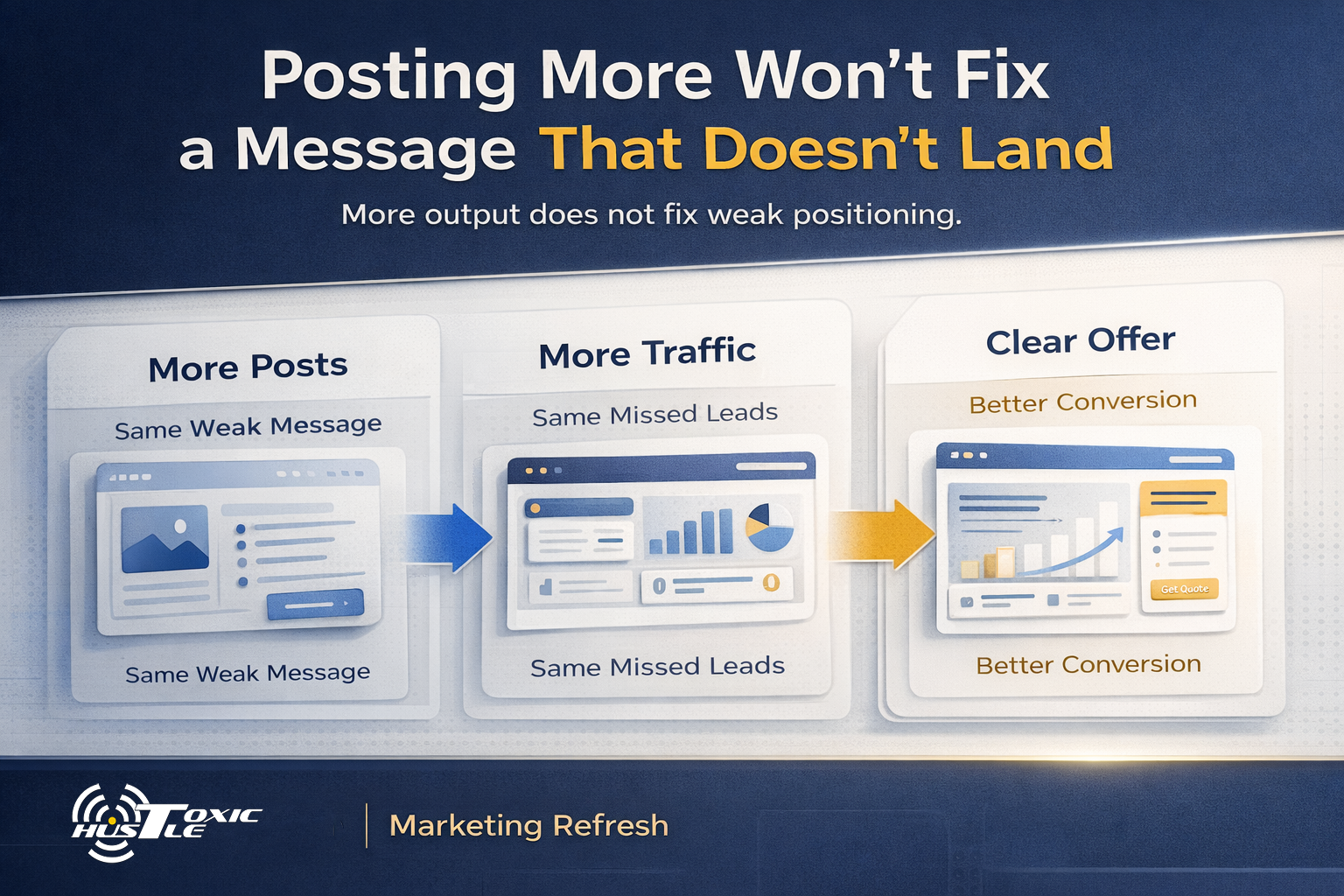
If your business is posting more but still not getting the right leads, the problem is usually not effort. It is usually a message problem.
A vague offer, broad homepage copy, generic service pages, and content that is disconnected from buyer intent will make even high-volume posting underperform. More output can increase activity, but it does not automatically increase relevance, trust, or conversion.
That is why a marketing refresh should start with clarity, not volume.
Table of Contents
- The Trap: Why Businesses Keep Hearing “Post More”
- Why More Output Does Not Fix Weak Positioning
- Signs Your Message Is Not Landing
- Why AI Content Makes This Worse When Strategy Is Off
- What Actually Helps
- What a Marketing Refresh Should Fix First
- A Simple Diagnostic Table
- Frequently Asked Questions
- Final Take
Key Takeaways
- More content does not fix a weak message.
- Businesses often confuse activity with clarity.
- Low-quality inquiries, weak conversion, and traffic with no action are usually messaging problems before they are traffic problems.
- AI can speed up production, but it can also scale weak positioning faster.
- The best first move is usually a tighter offer, clearer homepage copy, stronger landing pages, and content tied to actual buyer intent.
The Trap: Why Businesses Keep Hearing “Post More”
A lot of businesses are not failing because they are lazy.
They are failing because they keep getting told the same recycled advice:
- post more
- be on more platforms
- stay active
- publish every day
- use AI to move faster
On paper, that sounds productive.
In real life, it turns into a mess.
The owner is already running the business. The team is already stretched. Nobody has time to become a full-time media company just to keep up. So what happens?
They start posting whatever they can.
A few graphics. A few updates. A few generic tips. Maybe some AI-assisted captions. Maybe a blog here and there. Maybe a homepage that tries to say everything at once.
Then they wait for leads.
And when the leads do not improve, they assume the answer is more output.
That is the trap.
The problem is not always that the business is invisible.
The problem is often that the message does not connect fast enough, clearly enough, or directly enough to the problem the buyer is trying to solve.
Why More Output Does Not Fix Weak Positioning
Content can amplify a strong message.
It can also amplify confusion.
If your positioning is weak, more posting just gives that weak positioning more places to underperform.
Here is what weak positioning usually looks like:
- Your homepage describes the company but not the problem you solve.
- Your service pages are broad and generic.
- Your content sounds nice but does not move people toward action.
- Your calls to action are soft, vague, or buried.
- Different pages sound like they were written for different businesses.
When that is the setup, posting more does not solve the real issue.
It just creates more surface area for people to bounce.
Activity vs. effectiveness
| What teams think | What is actually happening |
|---|---|
| “We are posting consistently.” | The message is being repeated, but not understood. |
| “We are getting traffic.” | Visitors are showing up, but they are not finding enough relevance to act. |
| “We are active on social.” | Social activity is not translating into qualified intent. |
| “We launched more content.” | More content is feeding the same weak positioning problem. |
The problem is not motion.
It is message-market fit.
Signs Your Message Is Not Landing
You do not need a giant analytics setup to spot this.
Usually, the signs are right there.
Low engagement from the right people
This does not mean every post needs to go viral.
It means the people you actually want to hear from are not responding with real intent.
You may still get likes, random impressions, or generic approval. That is not the same thing as relevance.
If your ideal buyer is not clicking, replying, inquiring, or sharing your content with context, your message may be too broad or too weak.
Generic inquiries
When your message is vague, the leads usually are too.
You get questions like:
- “How much do you charge?”
- “Can you help with marketing?”
- “What exactly do you do?”
- “Do you do websites too?”
Those are not always bad questions, but they often mean your site and content did not do enough pre-qualification.
Strong messaging creates stronger inquiries.
Weak messaging creates friction at the exact point where clarity should already exist.
Traffic with no action
Traffic by itself is not proof that the message is working.
If people land on the page, scroll a bit, and leave, that usually means one of these things is happening:
- they did not see themselves in the problem fast enough
- the offer felt too broad
- the page did not make a strong next step obvious
- the content and page did not match the intent that brought them there
That gap matters.
Because traffic without action is usually where teams start panicking and posting more, when the real fix should have happened on the page.
Pages that look fine but do not convert
This is one of the biggest traps in modern marketing.
A page can look clean and still be weak.
A homepage can be modern and still say almost nothing.
A landing page can be attractive and still fail because it tries to speak to too many buyers at once.
Design matters. But design without message clarity is just a nicer way to confuse people.
Visual: Where the leak usually happens
| Funnel Stage | What the business sees | What the buyer feels | What it usually means |
|---|---|---|---|
| Social post | “People saw it.” | “I still don’t get why this matters to me.” | Hook is weak or too generic |
| Homepage visit | “Traffic is coming in.” | “This feels broad.” | Message is slow or unclear |
| Service page visit | “They clicked.” | “I’m not sure this is for my problem.” | Page lacks specificity |
| Inquiry stage | “Leads are random.” | “I still need to ask what you really do.” | Positioning is vague |
| Sales follow-up | “People ghosted.” | “I didn’t feel urgency or fit.” | Offer and message were not sharp enough |
Why AI Content Makes This Worse When Strategy Is Off
AI is not the villain here.
Bad strategy is.
AI can help businesses move faster. It can help draft ideas, repurpose content, speed up production, and support execution.
But when the positioning is off, AI often makes the problem scale faster.
How that happens:
- It produces more content around a weak core message.
- It makes generic copy easier to publish at volume.
- It can blur the difference between sounding polished and actually being relevant.
- It encourages output before clarity.
That is why businesses sometimes feel busier after using AI, but not more effective.
They created more activity. They did not create more connection.
AI done wrong vs AI done right
| AI done wrong | AI done right |
|---|---|
| Speeds up vague marketing | Speeds up already-clear strategy |
| Produces generic posts | Helps repurpose targeted messaging |
| Makes pages sound polished but broad | Supports sharper landing page execution |
| Increases volume without intent | Increases output tied to real buyer problems |
The real move is not “use AI more.”
It is “get the message right first, then let tools help you move faster.”
What Actually Helps
This is the part people keep skipping.
If your message is not landing, you do not need to immediately spin up more platforms, more posts, or more tools.
You need clarity.
1. A clearer offer
A lot of business messaging is too soft.
It talks around the work instead of naming what the business actually helps solve.
A clearer offer answers:
- what do you do
- who is it for
- what problem does it solve
- what outcome should they expect
- what should they do next
If that does not come through fast, the message is already slipping.
2. A tighter homepage message
Your homepage is not supposed to say everything.
It is supposed to make the business easier to understand and easier to act on.
That means your homepage should quickly communicate:
- the core problem you help solve
- the type of buyer you help
- the main outcome or transformation
- the clearest next step
If the homepage tries to sound clever instead of clear, people leave.
3. Problem-based landing pages
Different buyers come in with different intent.
That means one generic page is rarely enough.
If your business solves multiple problems, you need pages that speak directly to those problems.
For example, a company might need separate pages for:
- lead generation issues
- outdated website conversion issues
- local visibility issues
- content production drag
- automation and operations cleanup
When the page matches the problem, relevance goes up.
And when relevance goes up, conversion usually does too.
4. Content tied to buyer intent
Not all content needs to sell directly.
But it should still serve a purpose.
The best content usually does one of these things:
- names a specific problem
- reframes a common misunderstanding
- shows proof or process
- helps the buyer diagnose a gap
- moves someone toward a clearer next step
That is very different from posting just to stay active.
What a Marketing Refresh Should Fix First
This is where businesses usually need a reality check.
A marketing refresh is not just about making things look newer.
It should fix the parts that are stopping the message from landing.
Start here first:
1. Clarify the offer
Can someone understand what you do without digging through your whole site?
2. Rewrite the homepage around the problem
The page should connect to what the buyer is already worried about, not just what the company wants to say about itself.
3. Build or tighten key landing pages
If different services solve different pain points, stop asking one page to carry all of them.
4. Align content with real search and buyer intent
Your blog, social content, and page copy should support the actual problems buyers are trying to solve.
5. Tighten your calls to action
If the next step is vague, soft, or buried, people will not take it.
A Simple Diagnostic Table
Use this to pressure-test whether the issue is really volume or whether it is clarity.
| Symptom | What teams often assume | What is more likely true | First fix |
|---|---|---|---|
| Low engagement | “We need to post more.” | The message is too broad or too weak. | Tighten hook and positioning. |
| Generic inquiries | “Leads are low quality.” | The site is not pre-qualifying well. | Clarify offer and service pages. |
| Good traffic, weak conversion | “We need more traffic.” | The page is not matching buyer intent. | Improve page relevance and CTA. |
| Constant content fatigue | “We need a bigger content plan.” | The business is overproducing without strategy. | Reduce volume and sharpen message. |
| AI-assisted content feels flat | “AI is not working.” | AI is amplifying weak direction. | Fix strategy before scaling output. |
Quick Self-Audit Checklist
Use this before you decide your business needs “more content.”
- Can a first-time visitor understand what you do in a few seconds?
- Does your homepage lead with a real business problem?
- Do your service pages speak to specific buyer intent?
- Are your calls to action clear and visible?
- Does your content support the offer or just keep the feed alive?
- Are you attracting the right inquiries or just more inquiries?
- Is AI helping you execute a clear plan or just making more noise faster?
If several of these answers are shaky, posting more is probably not the move.
Frequently Asked Questions
Is posting consistently still important?
Yes. Consistency matters.
But consistency only becomes valuable when it reinforces a clear message. If the positioning is weak, consistent posting just repeats the same weak signal.
How do I know if I have a traffic problem or a message problem?
Usually, if traffic exists but action is weak, it is a message or page problem first. If nobody is finding the business at all, then visibility may be the issue. A lot of businesses have both, but message clarity should still be fixed early.
Can AI still help with content?
Absolutely. AI can be useful for drafting, repurposing, outlining, and speeding up execution. It just works better when the offer, page structure, and messaging are already clear.
Do I need a full rebrand to fix this?
Usually not.
A lot of businesses do not need a full rebrand. They need a clearer offer, tighter homepage messaging, more focused landing pages, and content tied to real buyer intent.
What should I fix first if I only have time for one thing?
Fix the main message on the homepage and the top service or landing page that should be driving work right now. That usually creates the clearest downstream impact.
Final Take
If your content feels busy but the business is still not getting the right traction, the answer is probably not to post even more.
It is to stop and fix the message.
Clearer offer.
Sharper homepage.
Problem-based landing pages.
Content tied to intent.
That is how a business stops sounding active and starts sounding relevant.
And relevance is what gets remembered, clicked, and contacted.
CTA: Start With Clarity, Not Volume
If your site, pages, or content feel active but not effective, that gap is usually fixable.
The smartest next move is not always more content.
It is a sharper message that lands faster.
Want a second set of eyes on your message, pages, or offer? Start with a marketing refresh before you commit to more volume.