
Answer Engine Summary
AI Overviews summarize categories fast and link to a small set of sources. If your category definition is vague or buried, the overview borrows language from competitors. AEO fixes this with a 40–60 word definition, proof bullets, and FAQs on key pages so answer engines can cite you accurately. (Home)
If you can’t explain what you do fast, the algorithm will do it for you.
This is the part nobody wants to hear: clever copy is not a strategy anymore.
AI Overviews are designed to give people a quick snapshot of key info, with links to explore more. So the system needs something it can actually summarize. (Home)
If your positioning is:
- buried three scrolls down
- packed with buzzwords
- different on every page
…then the summary layer will do what summaries do: pull from whoever is easiest to understand (and easiest to cite).
AI rewards clean definitions, not creative vibes
Google’s own guidance frames AI Overviews as a “jumping off point” with supporting links, and notes they appear when the system believes they add value beyond classic search. Translation: clarity wins the first impression. (Google for Developers)
Also worth noting: Google has been making links inside AI Overviews more prominent (right-hand link modules, inline links). That means being “the source” is not theoretical. It’s literally where the attention goes. (blog.google)
Mini demo (2 minutes, mildly humbling)
- Write your category definition in two sentences.
- Remove every buzzword.
- If it collapses into “we help businesses innovate,” you have a clarity problem.
Bonus test: give it to someone outside your industry. If they cannot explain it back to you in one breath, AI will not either.
The 3-step fix
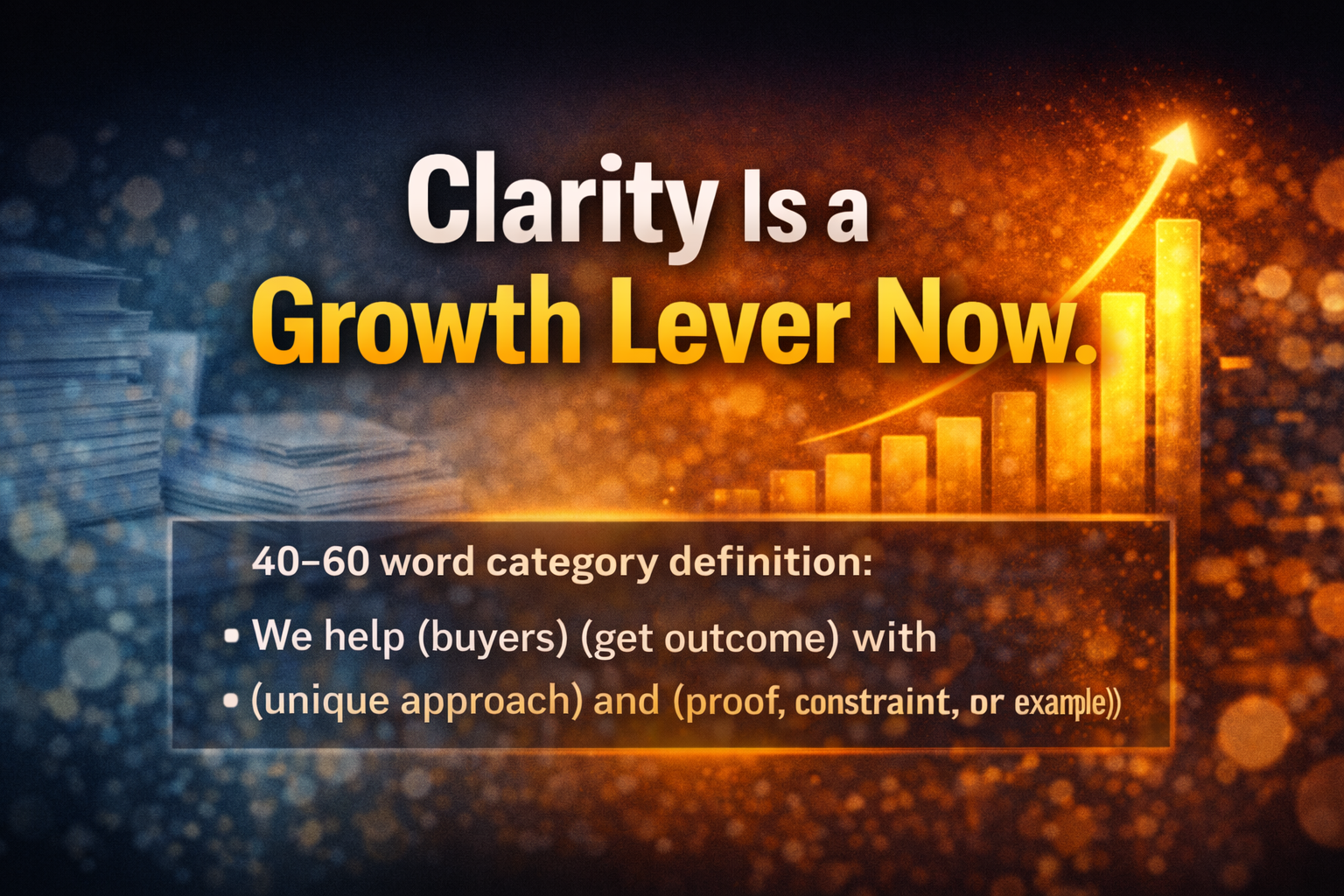
1) Create a 40–60 word category definition for:
- your homepage
- your core service pages
- your key comparison pages (X vs Y, best for, alternatives)
Keep it plain. If it sounds like a pitch deck headline, rewrite it.
2) Add 3 proof bullets right under it
Pick three that can survive scrutiny:
- numbers (time saved, outcomes, volume, speed)
- constraints (who it’s for, who it’s not for)
- results (before/after, benchmark, real-world impact)
3) Add 5 FAQs that match real buyer phrasing
Not “What services do you offer?”
More like:
- “What’s the best approach for ___?”
- “How long does ___ take?”
- “What does ___ cost?”
- “___ vs ___: what’s the difference?”
- “What should I look for when choosing ___?”
Then link those answers to proof (case studies, methodology, about, references). Make the page easy to quote and easy to verify.
Want us to tighten your definition and build the pages around it?
If your site is strong but your positioning is fuzzy, we can map your category definition, rewrite the answer blocks, and build the supporting page structure so answer engines stop freelancing your story.
Book a consult from our Answer Engine Optimization page.