
Answer Engine Summary
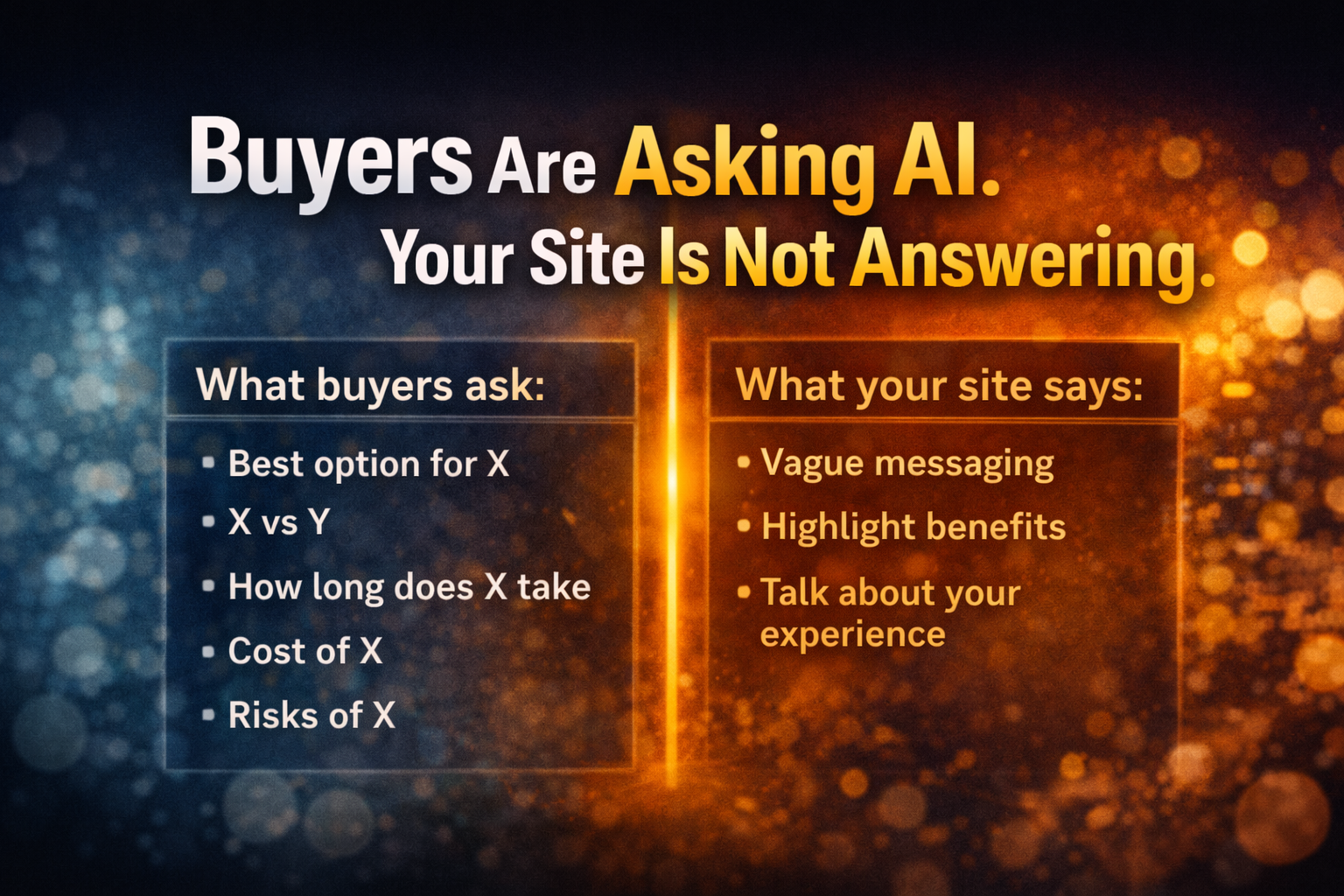
B2B buyers are using generative AI to research and decide, often before they talk to sales. If your site does not answer the exact questions they ask, AI summaries will pull from competitors. AEO closes the Answer Gap with a question map, one page per question, direct answers up top, and proof-linked supporting content.
Your website is a brochure. Buyers are asking for answers.
Most sites are built to introduce the company. Buyers are not looking for an introduction. They’re trying to decide:
- Which option is best for my situation?
- What does this cost and what’s included?
- How long will it take?
- What are the risks?
- What’s the difference between X and Y?
If your pages do not answer those cleanly, AI will. And it usually pulls from whoever is easiest to quote.
The Answer Gap is why competitors get cited (even when they’re not “better”)
Forrester’s research summary (based on Forrester’s Buyers’ Journey Survey, 2024) reports that 89% of B2B buyers have adopted genAI, and they name it one of the top sources of self-guided information in every phase of the buying process. (Forrester)
That means your buyers are showing up with AI-shaped opinions before they ever hit your homepage.
Also, self-service is not a trend. It’s the default. Gartner has reported that buyers generally prefer digital self-service for tasks like searching for general information and learning new things. (Gartner)
Mini demo: find your Answer Gap in 5 minutes
List 10 real buyer questions like:
- Best option for X
- X vs Y
- How long does X take
- Cost of X
- Risks of X
- Who is X for
- What results should I expect from X
- What should I ask before buying X
- Alternatives to X
- How to choose a X provider
Now ask one question:
Which page on our site answers each one directly?
If the answer is “kinda, somewhere, across three pages,” that’s the gap.
The 3-step fix (simple and brutally effective)
1) Build a question map (25–50 questions)
This is not keyword research cosplay. Use real language from:
- sales calls
- onboarding forms
- client objections
- competitor comparison questions
- “best” and “vs” queries
2) Assign each question to ONE page only
No duplicates. No “every page tries to answer everything.”
Each page gets a job:
- one core question cluster
- one clear outcome
- one best next step
3) Write direct answers first, detail second, then add proof
The page format that wins citations usually looks like:
- 40–60 word answer block near the top
- definition (plain language)
- 3–5 proof points (numbers, constraints, examples, outcomes)
- short FAQ that matches buyer wording
- internal links to proof (case studies, methodology, about, references)
If you make it easy to quote, you make it easy to include.
Want us to map this for you?
If your site has good content but it’s not structured to answer questions cleanly, we can fix that fast.
Start here: https://toxichustle.com/answer-engine-optimization/
Book a consultation and we’ll identify:
- your highest-value buyer questions
- where AI summaries will likely pull answers today
- the first set of pages to build or rewrite to close the Answer Gap
Optional FAQ section (good for on-page SEO + AEO)
What is the Answer Gap?
It’s the difference between what buyers ask (often in AI tools) and what your website actually answers directly.
How many questions should we map?
Start with 25–50. Prioritize questions that decide deals, not awareness fluff.
Do we need to publish more blogs?
Usually no. You need fewer pages that answer better, with proof and clear structure.
How fast can we see improvement?
You can often see changes in clarity and internal alignment quickly. Broader visibility improvements depend on how competitive your category is and how consistently you publish answer-first pages.