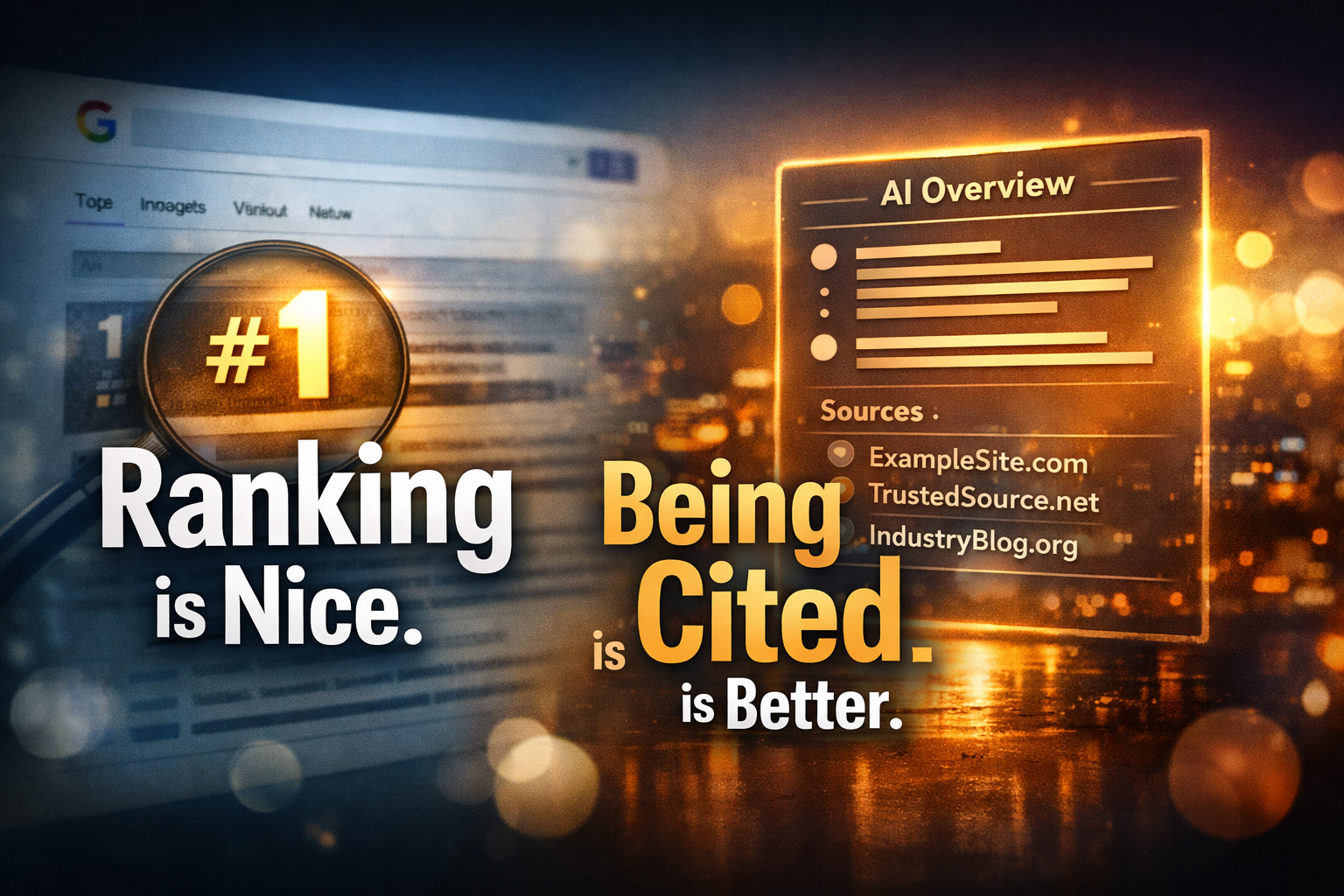

Quick Answer: Ranking is Nice. Being Cited is Better.
AI Overviews and other answer engines often summarize a category using only a few sources. You can rank in traditional results and still get skipped in the summary. AEO makes your site easy to quote by mapping buyer questions, building source-of-truth pages, and adding clear answer blocks plus schema. (blog.google)
You can be ranking and still be invisible.
If you have ever searched your own category and thought “we’re doing fine,” but your brand never shows up in the AI summary, you have discovered the new gap.
AI Overviews appear when Google’s systems decide they’re helpful, and they’re built to help people explore by showing prominent web links. Translation: the “answer layer” is now part of the search journey, not a bonus feature. (blog.google)
Ranked vs referenced is not the same game
Traditional SEO rewards relevance and authority to earn a position on a results page.
Answer engines reward:
- clarity (direct answers, not vague marketing lines)
- structure (pages that are easy to extract from)
- consistency (the same story across your key pages)
- trust signals (credible sources, proofs, and citations)
And yes, when an AI summary appears, people are less likely to click links. So being included in the summary is not vanity. It is visibility at the moment of decision. (Pew Research Center)
Mini demo: check if you’re being cited
Do this in 3 minutes:
- Search a high-intent query in your category (think “best,” “top,” “how to,” “X vs Y”).
- If an AI overview shows up, scroll and look at the sources/citations.
- If your site is not listed, you have a visibility gap even if you rank somewhere below.
Repeat this for 5–10 queries that actually decide deals.
The 3-step fix (simple, not “create 40 blogs”)
1) Pick 10 buyer questions that decide deals
Not “awareness” questions. Decision questions:
- “Who is best for ___?”
- “What is the best way to ___?”
- “___ vs ___”
- “How much does ___ cost?”
- “What are the risks of ___?”
2) Build one “source of truth” page per question cluster
One strong page beats five scattered ones. Each page should have:
- a short definition
- a direct answer
- supporting proof (examples, constraints, outcomes, screenshots, data, citations)
- internal links to deeper pages (case studies, methodology, service pages)
3) Add an answer block + structure that AI can lift cleanly
Do this on every source page:
- 40–60 word answer block near the top (like the one above)
- question-based headers (the same phrases people search)
- a tight FAQ section (real buyer wording)
- basic structured data where relevant (FAQPage, Organization, Article, HowTo)
Google explicitly frames AI Overviews as a way to help people “quickly find information” and “explore relevant sites across the web,” which is why clean structure and clear answers matter. (blog.google)
If you want the fast version (no fluff)
If you want to know whether AEO will matter for your brand, the quickest path is:
- identify your must-win questions
- check whether you’re cited today
- map the gaps to a short list of pages to build or fix
If you want help doing that without wasting months guessing, book an AEO consultation from our Answer Engine Optimization page.